
“It’s not brilliance. It’s just
avoiding stupidity.”
Warren Buffet’s 60-year investing partner, Charlie Munger, has famously said this more than once about the astonishing success of Berkshire Hathaway over 60 years. But what comprises stupidity? Is it one-time foolishness or a pattern of dumb?
A reckless mistake, or a poorly devised strategy, or just a bad habit? Can someone of average intelligence achieve truly impressive
investment returns?
A reckless mistake, or a poorly devised strategy, or just a bad habit? Can someone of average intelligence achieve truly impressive
investment returns?
In truth, the list of “don’t’s” in stock investing is
probably longer than the list of ”do’s”. But they’re both more intuitive and
less technical in a lot of ways. Which means they’re more accessible to regular
folks who have never studied finance or who have crazy schedules and simply
can’t put in the time to nail the details. Which is to say, if you can just
avoid touching the third rail, you’ll probably do fine.
probably longer than the list of ”do’s”. But they’re both more intuitive and
less technical in a lot of ways. Which means they’re more accessible to regular
folks who have never studied finance or who have crazy schedules and simply
can’t put in the time to nail the details. Which is to say, if you can just
avoid touching the third rail, you’ll probably do fine.
Don’t invest in
mutual funds.
mutual funds.

I go into more depth on this subject in another
post, but I’ll nutshell it here: if after reading all my investing how-to
you still feel like you aren’t ready to pick your own stocks, get yourself an
online brokerage account at E*Trade
or TD
Ameritrade and pick up a couple of ETFs (exchange traded
funds), which hold a basket of companies but trade as a single stock. The
easiest are the large-basket ETFs like VOO and SPY, which mimic the
movement of the largest market index of 500 different stocks. If instead you
insist on paying a professional fund manager to hand-pick stocks for a mutual
fund, you’ll pay 1-2% of your assets for that manager’s
‘expertise’—which frequently does not outperform your own common sense—and your
money will be much less liquid should you need to access it. The vast majority
of mutual funds do no better than the broader market and you pay for the
privilege. Don’t believe me? Read this
and this,
by other people.
post, but I’ll nutshell it here: if after reading all my investing how-to
you still feel like you aren’t ready to pick your own stocks, get yourself an
online brokerage account at E*Trade
or TD
Ameritrade and pick up a couple of ETFs (exchange traded
funds), which hold a basket of companies but trade as a single stock. The
easiest are the large-basket ETFs like VOO and SPY, which mimic the
movement of the largest market index of 500 different stocks. If instead you
insist on paying a professional fund manager to hand-pick stocks for a mutual
fund, you’ll pay 1-2% of your assets for that manager’s
‘expertise’—which frequently does not outperform your own common sense—and your
money will be much less liquid should you need to access it. The vast majority
of mutual funds do no better than the broader market and you pay for the
privilege. Don’t believe me? Read this
and this,
by other people.
Don’t worry about the
price of a share.
price of a share.
Lots of people get weirded out by the cost per share. They
think that if a share is $500 and they can only afford one share, better to
find something for $100 per, or $20 per share and buy more shares. Which is
ridiculous: if you’re going to spend the same dollar amount, and the company is
going to rise, say, 10% in the next year, then you’re 10% wealthier either way.
Go with the company which best fits your investment model and your interests.
think that if a share is $500 and they can only afford one share, better to
find something for $100 per, or $20 per share and buy more shares. Which is
ridiculous: if you’re going to spend the same dollar amount, and the company is
going to rise, say, 10% in the next year, then you’re 10% wealthier either way.
Go with the company which best fits your investment model and your interests.

The other thing that happens is that people avoid companies analysts
describe as “overvalued,” whose shares have risen substantially over recent
months. The thinking is that if it’s gone up that much it’s probably close to
tapped out, and the price will flatten or even fall. But the truth is, no
matter what analysts say, that stock’s price has risen because investors
overall have decided it’s worth a lot more than previously thought. Perhaps the
company acquired a competitor, or
announced some international expansion, justifying the rise. If instead you only buy
stocks that you think are undervalued or “on a dip,” you miss out on some
amazing opportunities (think Apple, Amazon, Netflix). Companies with rising
valuations tend to keep rising until something changes—a new competitor, a
corporate scandal, an economic shock. If
you stop worrying about how high the price looks today, and measure it instead against the potential for that
business tomorrow, you’ll have a much clearer understanding of the future value, which
is why you want to own it in the first place.
describe as “overvalued,” whose shares have risen substantially over recent
months. The thinking is that if it’s gone up that much it’s probably close to
tapped out, and the price will flatten or even fall. But the truth is, no
matter what analysts say, that stock’s price has risen because investors
overall have decided it’s worth a lot more than previously thought. Perhaps the
company acquired a competitor, or
announced some international expansion, justifying the rise. If instead you only buy
stocks that you think are undervalued or “on a dip,” you miss out on some
amazing opportunities (think Apple, Amazon, Netflix). Companies with rising
valuations tend to keep rising until something changes—a new competitor, a
corporate scandal, an economic shock. If
you stop worrying about how high the price looks today, and measure it instead against the potential for that
business tomorrow, you’ll have a much clearer understanding of the future value, which
is why you want to own it in the first place.
Don’t buy blind.
When you hear from a friend or a trusted broker about a
great value stock or a sudden opportunity that “won’t last long,” your inclination is to believe they know something
you don’t and therefore you should jump. But it ought to be a red flag: if you’re hearing about it from
someone else, the likelihood is you’re not already following that business, or
you would already know this information. (Plus, if word has already gotten
around, then any amazing momentary price is likely already over.) Don’t succumb
to the temptation to get in with your friend just because. Do a little research.
Understand what the business does, who their competition is, what kind of
leadership they have, how their growth trajectory looks. Get a feel for things.
If you don’t understand how the company makes money today and how big the opportunity is the future, how can you possibly assess it as an investment? You’re buying an ownership stake in an ongoing business: you’re
much more interested in where they’re going than where they are or where
they’ve been.
great value stock or a sudden opportunity that “won’t last long,” your inclination is to believe they know something
you don’t and therefore you should jump. But it ought to be a red flag: if you’re hearing about it from
someone else, the likelihood is you’re not already following that business, or
you would already know this information. (Plus, if word has already gotten
around, then any amazing momentary price is likely already over.) Don’t succumb
to the temptation to get in with your friend just because. Do a little research.
Understand what the business does, who their competition is, what kind of
leadership they have, how their growth trajectory looks. Get a feel for things.
If you don’t understand how the company makes money today and how big the opportunity is the future, how can you possibly assess it as an investment? You’re buying an ownership stake in an ongoing business: you’re
much more interested in where they’re going than where they are or where
they’ve been.
Don’t be in a hurry.
Unlike in the movies, investing is not shorting orange juice
futures one time and finding yourself on a yacht in the Bahamas for the rest of
your life. Investing is a lifelong process. It requires an understanding that the
value of your assets will rise and fall in in the near term but, with patience,
will likely increase substantially over time.
futures one time and finding yourself on a yacht in the Bahamas for the rest of
your life. Investing is a lifelong process. It requires an understanding that the
value of your assets will rise and fall in in the near term but, with patience,
will likely increase substantially over time.
A lot of people succumb to action
bias, which is just the need to do
something with your investment
portfolio beyond just watching it grow. Because most folks don’t have an endless supply of incoming cash
with which to buy more or different stocks, they instead move the money they
have from one investment to another, looking for higher or faster returns. This
eliminates any one business’s ability to earn them a substantial return over
time, it kills the stunning advantage brought by compounding interest, it generates capital gains taxes and transaction fees, it takes time and energy
and increases frustration. Instead, buy smart and sit tight: investing, not
trading. Your returns will demonstrate the difference.
bias, which is just the need to do
something with your investment
portfolio beyond just watching it grow. Because most folks don’t have an endless supply of incoming cash
with which to buy more or different stocks, they instead move the money they
have from one investment to another, looking for higher or faster returns. This
eliminates any one business’s ability to earn them a substantial return over
time, it kills the stunning advantage brought by compounding interest, it generates capital gains taxes and transaction fees, it takes time and energy
and increases frustration. Instead, buy smart and sit tight: investing, not
trading. Your returns will demonstrate the difference.
Don’t let your
emotions take over.
emotions take over.
 Investing well, and I’ve said this before here,
and here,
requires a steady hand on the helm and your eyes on the horizon. There’s just
no way around it. Stocks rise over time, but in the shorter term they gyrate
all over the place and some of it is just plain sickening. This is especially
true of young companies, technology companies, and of so-called “fad”
companies, whose products or services might turn out to be just a momentary
cultural obsession (think Sodastream, GoPro, Crocs, Tesla) which analysts and
investors worry will fade in time. If you act on your emotions, you might save
yourself a headache or a sleepless night but over time you will have terrible
returns. Never buy on a whim of fancy, and never sell in a panic. (There are
exceptions, but you’ll know them when you see them—like Volkswagen.) Buy it with some
thought and analysis and some vision, then then sit on your stocks for years.
That’s it. Containing yourself is certainly hard, but it’s not complicated.
Don’t sell on movement.
Everyone sets out to buy low and sell high. But the reality
is often very different: we buy high (see “Don’t worry about the price,” above)
and sell when it drops because we fear it will keep dropping. Clearly, this will prove a poor strategy over time.
is often very different: we buy high (see “Don’t worry about the price,” above)
and sell when it drops because we fear it will keep dropping. Clearly, this will prove a poor strategy over time.
 Once you own shares, don’t sell unless you must. I go into
much greater detail in When
to Sell, but the basic idea is that, if you did at least a little due
diligence prior to purchase, and you still like the company and believe in
their capacity to grow, then you shouldn’t sell just because it has moved up
or down. Stocks swing, sometimes a lot, and sometimes very quickly. Selling
because it’s dropped substantially following a missed quarterly earnings report
(a Wall Street analyst’s problem, not the company’s or the shareholder’s
problem)— or worse, because it popped upwards, is exactly the kind of behavior
you want to avoid. You bought it to hold it, expecting it would slowly move
up— so let it. Sell only when something really bad has happened at the company
(again: Volkswagen) or when you need the money for something else. Trust your
purchase, trust your judgment. Patience is rewarded.
Don’t wait.
 You’ve been hearing it since you landed your first job, if not earlier: the longer you put off the start of your investing career, the less
time you’ll have to earn enough to stop working.
0
0
1
1447
8251
Zaga Investment Co
68
19
9679
14.0
Normal
0
false
false
false
EN-US
JA
X-NONE
/* Style Definitions */
table.MsoNormalTable
{mso-style-name:”Table Normal”;
mso-tstyle-rowband-size:0;
mso-tstyle-colband-size:0;
mso-style-noshow:yes;
mso-style-priority:99;
mso-style-parent:””;
mso-padding-alt:0in 5.4pt 0in 5.4pt;
mso-para-margin:0in;
mso-para-margin-bottom:.0001pt;
mso-pagination:widow-orphan;
font-size:12.0pt;
font-family:Cambria;
mso-ascii-font-family:Cambria;
mso-ascii-theme-font:minor-latin;
mso-hansi-font-family:Cambria;
mso-hansi-theme-font:minor-latin;}
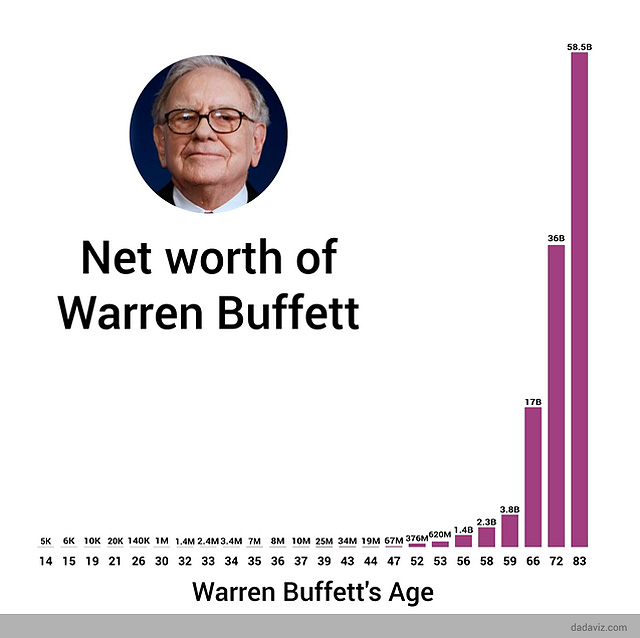
Take a look at this chart of Warren Buffett’s personal
wealth. Can you see the huge hockey-stick shape to the right? His net worth
grows steadily enough over time but really accelerates in the last decade or
so? That’s compounding interest. I keep saying it: the longer you do it, the
faster you’ll earn and the more you’ll have. Investing is the slow boat, so get
on now. For more on the subject of waiting to get started, have a look at
this.
wealth. Can you see the huge hockey-stick shape to the right? His net worth
grows steadily enough over time but really accelerates in the last decade or
so? That’s compounding interest. I keep saying it: the longer you do it, the
faster you’ll earn and the more you’ll have. Investing is the slow boat, so get
on now. For more on the subject of waiting to get started, have a look at
this.
 Zaga Investment Co
Leave a comment