
96
Normal
0
false
false
false
EN-US
X-NONE
X-NONE
/* Style Definitions */
table.MsoNormalTable
{mso-style-name:”Table Normal”;
mso-tstyle-rowband-size:0;
mso-tstyle-colband-size:0;
mso-style-noshow:yes;
mso-style-priority:99;
mso-style-parent:””;
mso-padding-alt:0in 5.4pt 0in 5.4pt;
mso-para-margin:0in;
mso-para-margin-bottom:.0001pt;
mso-pagination:widow-orphan;
font-size:12.0pt;
font-family:Calibri;
mso-ascii-font-family:Calibri;
mso-ascii-theme-font:minor-latin;
mso-hansi-font-family:Calibri;
mso-hansi-theme-font:minor-latin;}
investors than not knowing what to look for, and choosing the wrong
companies to buy. How do I know when a stock is
cheap? How do I tell if it will go up over time?
But that doesn’t work for me. I’m much
more interested in what a stock will do tomorrow than in what it did
yesterday– and I don’t believe I can learn much about tomorrow based on
yesterday. Which means I have to find other ways to value the companies I buy.
I need to look at non-financial criteria. I’ve written about this before. But because it gets so much
investor attention and because it seems so difficult to people starting out,
I’m going to revisit it here.
Most money managers try to steer an investment
portfolio by looking in the rear-view mirror
that I mean I want a company people have heard of, and one which is dominant
in an industry. Examples include Netflix and Apple. Sure, some people
gotta hate because these companies steamroll the competition (respectively:
cable TV/Blockbuster/neighborhood video rentals, and Microsoft-Dell-Gateway-Sony-Nokia-Blackberry …)
but that’s what makes them such compelling investments. These companies are so
strong they redefine the way business is done in their category. It is no
longer possible to have a realistic discussion about the state of retail without
mentioning Amazon, or about television without Netflix. They change
everything and as consumers we can either get on board or get left
behind.

2. Second, I like to see a wide moat. Simply put, this is the distance between the
business in question and the nearest competitor, which usually indicates the
difficulty of the competitor catching up in the next few years. A good example
is Starbucks. On the surface Starbucks sells a commodity– coffee. But what
makes them so valuable is they do it with panache: across a massive swath of
the globe, at tremendous profit (remember when we thought $3 for a cup of
coffee was crazy?) and they do it in their
ubiquitous neighborhoody, comfortable, jazz-infused stores. Sure
another business can mimic what they do– and thousands have– but Starbucks
has such a massive head start and with worldwide brand recognition and a
well-established level of quality product and service that no one can
realistically catch them for years to come.
Visa. Almost regardless of where you travel, time of day, language
spoken, or currency used, they take Visa. Even MasterCard can’t catch up. And
newer methods of payment– ApplePay, PayPal– are just alternative ways for
most people of using their Visa card (both systems tie into an existing card
account), and in any case are many years away from the level of saturation Visa
has worldwide.
 |
| Amazon’s AWS data center |
3. Next, I’m looking for a business which
is in strong growth mode. This one is obvious: a company
whose sales are expanding rapidly year over year as they add new stores, or put
out new products or services, or buy up their competitors (or kill them). It is
nearly impossible to value these businesses financially based upon their past
performance because in a lot of cases they’re growing too fast for last year’s
numbers to mean much. For example, a division of Amazon called Amazon Web
Services, or AWS, offers cloud computing services to other businesses (Netflix
among them). AWS is only a few years old but it’s currently growing at
something like 80% per year. In time it could be worth more than the company’s
“traditional” ecommerce business. A number of other, more
established technology companies have even abandoned the cloud services
industry in the face of Amazon’s juggernaut (Hewlett-Packard did that just that
last week). Partially as a result, Amazon’s stock valuation has increased
over 100% in 2015 alone. That’s a ride I want to be on.
with low debt. Typically, manufacturers have higher
fixed costs for heavy equipment and materials, so they must borrow more for
those items and maintain higher debt levels on their corporate books. By
contrast, software companies and online services generally have much less need
for serious capital (their highest costs are often their people) so they tend
to carry less debt. Generally speaking, a company with
relatively little debt has a lower bar to clear to make a profit, and therefore
has a much wider operating margin to work with. As a side benefit, businesses
carrying little debt can usually better weather difficult economic climates or
other sales downturns.
public company’s Balance Sheet. This can easily be found on Yahoo! Finance by
entering the company’s name in the Quote Lookup field.
Ideally (but not exclusively), Long Term Debt should total 25% or less of
the company’s annual revenues, which is available in the same location on
Yahoo!, but on the company’s Income Statement.
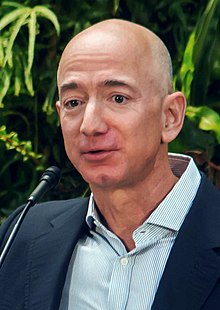 |
| Amazon Founder/CEO Jeff Bezos |
executive leadership. I want smart, transparent, confident
leaders who are less interested in Wall Street analysts’
quarterly expectations and more interested in long-term growth, product quality
and customer service. You can read interviews, listen to conference calls with
press, watch them on YouTube: are
the executives of your business providing clear direct answers to questions
posed? Are they worried about share prices or customer satisfaction? What do
they say about competitors, about new technology, about growth plans? Do they
come across as a little phony, a little slimy or more genuine and trustworthy?
Do you believe them? Like them?
my existing customer experience, and together they serve to enrich and deepen
my knowledge
is Berkshire Hathaway’s billionaire leader Warren Buffett. In his annual letters to
shareholders, Mr. Buffett comes across as down-to-earth, honest, folksy and
even funny. Whatever the business he’s describing he tells is like it is,
explaining how it works and why it’s important as he goes along. Reading his
letters is some of the best business education you can find, not to mention a
model for others and entertaining to boot.
which I have first hand customer experience.
I’ve found it invaluable: how better to judge a business’s performance
than by being a consumer of their products and services over time?
because most of do business with only a handful of public
companies relative to the thousands worldwide in which we
could invest. But in truth there is no shortage of investment
opportunities just among those: manufacturers of toothpaste and paper
towels, clothing and shoes, electronics and furniture, housing and automobiles,
sporting goods and appliances. Makers of entertainment products like books,
magazines, music, movies, television, video games. Service companies like
utilities and cellular, cable and internet, shopping clubs and online
retailers, banks and even brokerages.
athletic clothing to Nike’s both for fit and durability, and have since I
stumbled onto it about 10 years ago. I’m a huge fan of Amazon’s Prime service,
which is preferable for me rather than shopping around for vacuum filters
that fit, or having the right gas grill shipped to my door. Despite living
in Seattle my coffee snobbery has never advanced past Starbucks’ fresh roasted
espresso beans. I generally enjoy Disney’s
Marvel superhero movies. I’ve mentioned Netflix and Visa. Also there’s LinkedIn
and Twitter, IMAX and Zillow, all of which have come up with a great new
business concept or revolutionized an everyday process like career networking
or house shopping or movie-going.
unpaying one), I better understand the value proposition these businesses offer
and I’ve already got a finger on their pulse. I notice when quality slides or
new services are added, and this information informs my investment decisions.
Financial research and the news I read are additional to my existing, ongoing
customer experience. Together they work to enrich and deepen my
knowledge.
96
Normal
0
false
false
false
EN-US
X-NONE
X-NONE
/* Style Definitions */
table.MsoNormalTable
{mso-style-name:”Table Normal”;
mso-tstyle-rowband-size:0;
mso-tstyle-colband-size:0;
mso-style-noshow:yes;
mso-style-priority:99;
mso-style-parent:””;
mso-padding-alt:0in 5.4pt 0in 5.4pt;
mso-para-margin:0in;
mso-para-margin-bottom:.0001pt;
mso-pagination:widow-orphan;
font-size:12.0pt;
font-family:Calibri;
mso-ascii-font-family:Calibri;
mso-ascii-theme-font:minor-latin;
mso-hansi-font-family:Calibri;
mso-hansi-theme-font:minor-latin;}
close to 80% of what I need to know prior to investment– but you likely will
not find all 6 in one company very often. It happens, but those are rare. Look
to get several in one stock. I’ve listed several of them here, but there are
probably a couple of hundred if you look hard enough. This method is largely
unscientific and non-financial, and therefore is an unconventional way of
assessing a stock– but then being somewhat contrarian is my nature. Some pro
stock-pickers and market timers might poke fun at you; they certainly have at
me. Generally speaking, however, my returns crush theirs… though I don’t
think they believe my numbers. A high-class problem if there ever was
one.
If you reset your car’s side mirrors from reflecting your own rear fenders to reflecting that empty zone between the edge of your peripheral vision and the edge of what you can see in the rear-view mirror, then you will eliminate blind spots.
 Zaga Investment Co
Leave a comment